
From TV Carts to AI: How the Evolution of EdTech Supercharges Your Career
The days in the classroom are long, but the years are short—and nowhere is that more obvious than in how fast classroom technology has changed. One minute you’re rolling a black‑box TV cart down the hallway, and the next you’re trying to manage iPads, Chromebooks, and now AI tools that seem to multiply overnight. If you’re feeling a little dizzy from it all, you’re not alone—and that whiplash is actually one of your biggest career assets if you’re exploring a move into EdTech.
In this post, I’m going to walk you from TV carts to AI, show you the major “eras” of EdTech we’ve lived through, and—most importantly—help you see how your lived experience in each phase can make you stand out to EdTech employers.
From TV Carts and Computer Labs to Career Advantage

Student teaching in Chicago, 2004.
When I started teaching in Chicago Public Schools in the early 2000s, going to the computer lab was a special occasion, not part of your daily lesson plan. You’d line your students up, walk them down the hall, and pray that every desktop would actually turn on and connect to that slow‑loading website you’d built a whole lesson around.
Back in my first classroom, our “EdTech stack” looked something like this:
A shared computer lab your class might see once a week.
A black‑box TV on a rolling cart that lived in the hallway.
BrainPOP videos and Bill Nye echoing through the halls as students chanted, “Inertia is a property of matter.”
There was nothing seamless about it.
You were constantly adjusting on the fly:
If the lab was booked, you improvised.
If the website wouldn’t load, you pivoted.
If the TV cart wasn’t available, you pulled out chart paper instead.
Here’s the part most candidates miss when they talk about this era in interviews:
That scrappiness is gold.
When an EdTech company is trying to figure out why their product isn’t landing in real classrooms, they don’t need someone who has only seen 1:1 devices and perfect Wi‑Fi. They need the teacher who remembers scheduling computer lab time like library books and making “low‑tech” tools feel magical long before adaptive platforms existed.
If your first memory of EdTech is that TV cart, you’re not behind—you’re ahead. You understand what it means to teach when technology is a bonus, not a guarantee.
The Messy Middle: Projectors, Early iPads, and the Differentiation Era
Fast forward a few years.
I moved to a new school, and we got what felt like a miracle at the time: a classroom projector. Suddenly, I could hook up my laptop and project websites, pictures, workbook pages—anything I could pull up on a screen. That one change opened the door to real differentiated learning in a way I hadn’t experienced before.
I became obsessed with meeting every student exactly where they were.
That meant:
Creating multiple versions of the same lesson so each student had what they needed.
Projecting problems and visuals to keep the whole class anchored while small groups worked at different levels.
Using digital resources to fill in gaps and extend learning for students who were ready to fly.
Then came the iPads.
I was one of the first teachers in the US to have 1:1 iPads in my classroom. That sounds exciting until you realize there were no tools to manage them, no MDM, and no one telling you what the rules should be. I had to log in to every single device with my personal iTunes account just to get apps on them.
New fear unlocked:
Would my personal information end up on student devices?
Would my husband’s less‑than‑fourth‑grade‑appropriate music show up on an iPad mid‑lesson?
On top of that, filters were basically nonexistent.
We lent our iPad cart to the classroom next door, and when it came back, guess what was in the search history? “Big butts.” And yes, the students got results, because our Wi‑Fi had almost no content filtering at that time.
Meanwhile, I had the highest number of SPED students in a general education classroom at my school—13 of my students were receiving special education services. I was desperate for anything that could level the playing field. That’s when I started using tools like Learning A‑Z and Raz‑Kids on our iPads to differentiate reading levels and give every student a fair shot.
Here’s what this messy middle says about you (and what hiring managers hear when you tell these stories):
You’ve led change when there was no roadmap.
You’ve balanced opportunity with risk (device safety, privacy, appropriate content).
You’ve used technology to support SPED and diverse learners, not just to “spice up” a lesson.
You weren’t just “using iPads.” You were:
Implementing new tools.
Managing risk.
Designing differentiated experiences in real classrooms with real constraints.
That’s implementation.
That’s customer success.
That’s professional learning.
If you’re not turning those experiences into interview stories and resume bullets yet, you’re leaving so much value on the table.

When Devices Became the Norm: Chromebooks and Student Agency
By the end of my decade in the classroom, my world looked completely different.
Computer lab visits weren’t the highlight of the week anymore. Instead, I was managing a classroom full of iPads and Chromebooks, and that shift fundamentally changed how I could teach.
Some of the biggest changes:
Instruction moved from “everyone on the same page at the same time” to “small groups and individual paths,” supported by digital platforms.
Traditional textbooks gave way to interactive platforms like BrainPOP and Learning A‑Z that allowed for more personalized practice and content.
Data became part of daily instruction—real‑time progress, quick checks for understanding, and targeted interventions became possible in a new way.
The classroom itself transformed:
Less “sage on the stage,” more facilitator.
More student agency: students choosing tasks, using tools, and collaborating.
More tech leadership expectations placed on teachers—many of us became the unofficial tech support, PD providers, and troubleshooters for our buildings.
I’ll be honest: I adapted quickly. I turned my classroom into a student‑centered environment where I could step back and facilitate rather than control every moment. What still shocks me is how many classrooms are still fighting that shift today.
For your career in EdTech, this era proves that you:
Understand what it actually takes to move from teacher‑centered to student‑centered learning.
Know how digital tools support (and sometimes complicate) differentiation.
Have lived the tension between “this is powerful” and “this is overwhelming.”
So when you sit across from a hiring manager and say, “I’ve led teachers through the transition to student‑centered, tech‑integrated classrooms,” you can back it up with real stories—not theory.
TV Carts vs. AI: Why Your Context Beats Hype
Now we’re in the AI chapter.
Some educators are excited, some are terrified, and many are both. There’s a lot of noise, a lot of fear, and a lot of misunderstanding about what AI can and can’t do in the classroom.
I’ve seen the positive side firsthand mentoring students in a local high school incubator program. They use AI to:
Help write skits.
Draft elevator pitches.
Build business plans.
But here’s the key: those same students can stand up, present confidently, and clearly understand what they’re talking about. That, to me, is the sweet spot—using AI to accelerate the work, not to replace the learning.
Recently, I found myself in a social studies teacher’s office, showing my son an old microfiche machine. It hit me how limited our learning was back then:
You went to the card catalog.
You found the 1–2 resources your library happened to have.
You read them and assumed they were the whole story.
Today, the world is at students’ fingertips—for better or worse. If we use AI and other EdTech tools well, students can access a much wider range of sources, compare perspectives, and make more informed decisions.
This is where your experience becomes especially powerful to EdTech employers:
You remember scarcity (microfiche, limited textbooks, early internet).
You live in abundance (AI tools, endless digital content, always‑on devices).
You understand why both parents and teachers feel excited and scared at the same time.
That makes you uniquely qualified to:
Design and support tools that balance efficiency with deep learning.
Talk about AI in a grounded, classroom‑tested way instead of repeating buzzwords.
Build products and programs that respect both the magic of technology and the irreplaceable role of the human teacher.
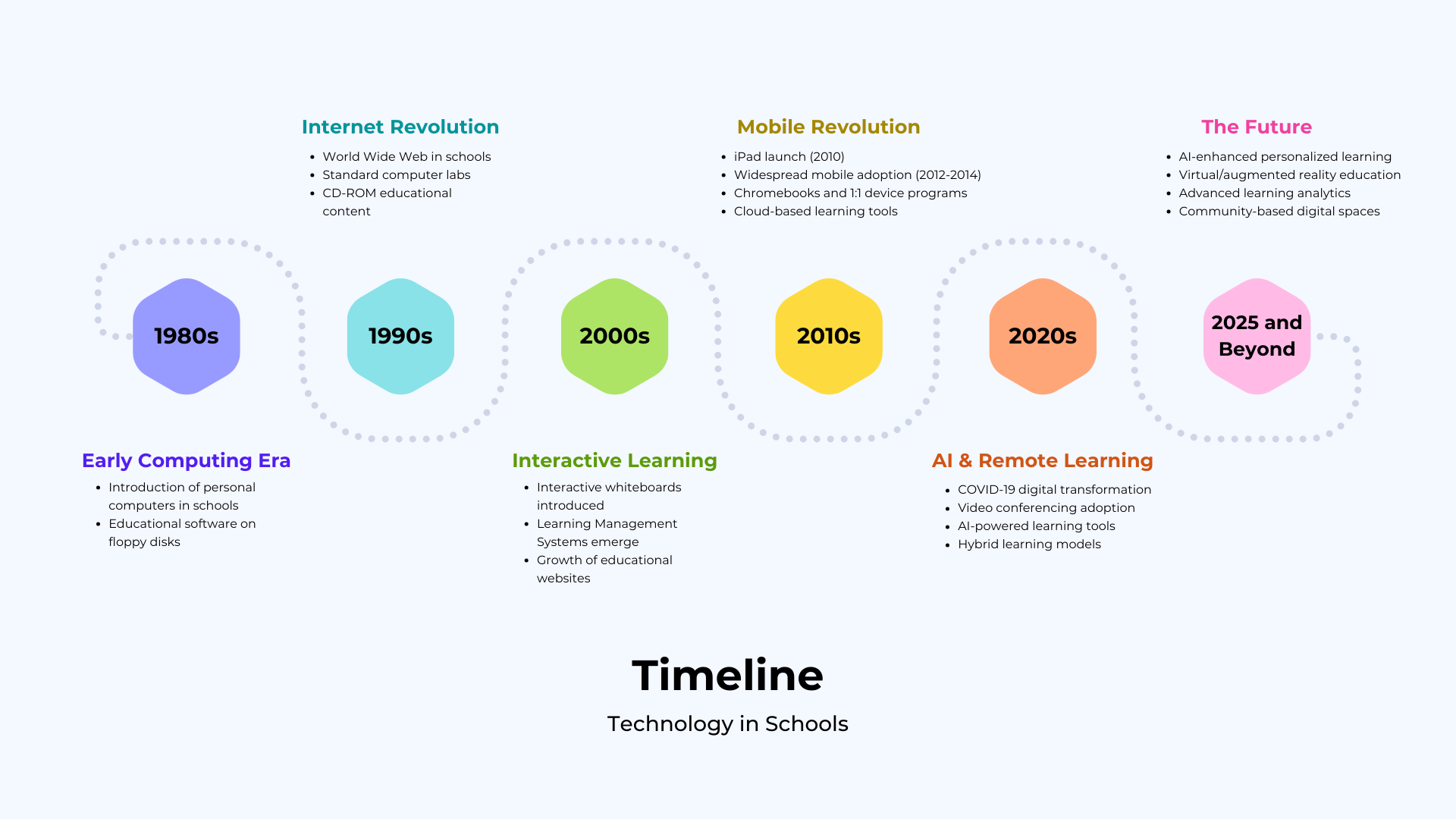
Join EdTech School to get timelines, study guides, and product training that help you stand out in interviews and advance your career.
Key Lessons from TV Carts to AI (and How to Use Them in Your Career)
Let’s zoom out for a moment and look at what this evolution really shows about you—and how to talk about it when you’re breaking into or growing in EdTech.
From Chapter One of my book, The Ultimate Guide to Working in EdTech, there are four big takeaways from the evolution of EdTech:
TV carts to AI: Simple tools became personalized platforms. You’ve seen the shift from “press play on the TV cart” to adaptive, AI‑driven platforms that respond to each learner.
Evolving teacher roles: Instructors became facilitators and tech leaders. You know what it looks like when teachers move from delivering content to orchestrating learning experiences.
Expanded learning access: We moved from limited local resources to nearly unlimited global information. You’ve navigated both scarcity and overload, and you know students need guidance, not just access.
Balanced integration: The best classrooms blend strategic tech use with strong human connection. You’ve seen technology enhance relationships—and you’ve seen when it gets in the way.
In an EdTech interview or networking conversation, you can turn these into powerful talking points. For example:
Instead of saying:
“I used technology in my classroom.”
Try:
“I’ve taught through multiple waves of EdTech—from TV carts and computer labs to Chromebooks and AI—and I’ve led my students and colleagues through each transition. That means I deeply understand the real‑world barriers to adoption and what it takes to design and implement tools teachers will actually use.”
That’s the kind of line that makes a hiring manager sit up straighter.
Turn Your EdTech Story into a Career Asset
If you’ve been teaching long enough to remember the TV cart days—or even if your career started in the Chromebook era—you are sitting on a goldmine of EdTech experience.
You’ve:
Survived slow‑loading websites and fragile lab schedules.
Navigated early iPad chaos, filters that didn’t work, and stolen devices.
Built student‑centered, tech‑rich classrooms before it was trendy.
Watched AI go from abstract buzzword to something your students use every day.
The next step is not “get more experience.” You already have it.
The next step is learning how to translate that experience into the language of EdTech roles, resumes, and interviews.
If you’re ready to do that, here’s what I recommend:
Start by mapping your own “TV Carts to AI” timeline—note the tools you used, the problems you solved, and the moments you led change.
Turn each era into 1–2 concrete stories you can use in interviews or on your LinkedIn profile.
And if you want support, templates, and a community that understands this journey, join EdTech School. Inside, you’ll find resources such as access to The Ultimate Guide to Working in EdTech, Kickstart, and EdTech Product School, and many downloadable resources.
